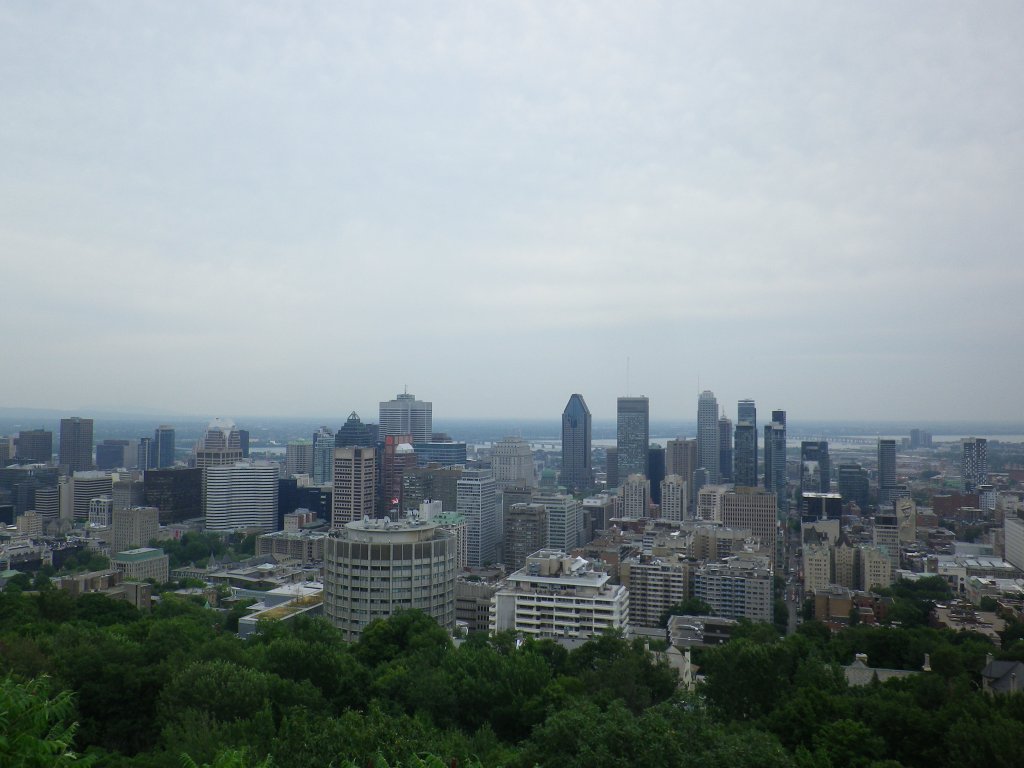
Montreal is the second most populous city of Canada and the first of the province of Quebec. It is one of the cities we will focus on for this blog and we start with its presentation.
Summary of Montreal’s history
The hill that dominates the emplacement of the actual city of Montreal was named “Mont Royal” when Jacques Cartier visited this place in 1535. The founder of Quebec City Samuel de Champlain, had decades after the ambition of creating a fur-trade site, while the Iroquois village discovered by Jacques Cartier had disappeared. But the first real settlement of Montreal was a missionary centre created in 1642, named at that time Ville-Marie. The city grew in the 18th century while wars against British forces succeeded to wars against Iroquois. All the New France, Montreal included, became British in 1763. In the 19th century, while Montreal became a modern city, the economic, industrial and cultural centre of Canada and even its capital for a few years, there were tensions with the French Canadians which felt economically and politically subordinated, and tried several rebellions. After the world war 2, Montreal lost its position of economical capital of Canada for the benefit of Toronto, what was reinforced by the Quiet Revolution in the 1960s (a set of reforms to strengthen the role of francophone society and government institutions in Quebec). Montreal stayed important internationally through the organisation of the Expo 67 and the expensive 1976 Olympic Games. As a conclusion Britannica says that Montreal remains in the 21st century “a growing, dynamic city with a diverse economy and a cultural life that was as rich as its history”.
Montreal and ecology
To have this historical background of Montreal in mind could be useful to understand the position and the role of Montreal in its country and its region, that explain its status of global city. Montreal was ranked in the category Alpha- in 2018 by the GaWC which make a classification of global cities based on their relations.
As a global city with an urban area of 4 million people, Montreal has to face environmental issues to meet its population’s needs while preserving its health and reducing its ecological footprint. In this domain, the city of Montreal shows its willingness to implement a rather ambitious policy to become more sustainable. The new mayor was elected in 2017 with a program declared strongly in favour of sustainable development. Montreal is also part of the network “100 resilient cities” of the Rockefeller Foundation which focus notably on adaptation to climate change. The city released a Resilience Strategy whose orientation 2 is “take action to protect our living environment”, with for example engagements about water management or reduction of heat island effect. The last sustainable plan of Montreal, for the period 2016-2020, remind that during the COP21, “Montréal ratified the Paris City hall Declaration and committed to reducing its GHG emissions by 80% by 2050”, what is a quite ambitious objective. Montreal is a Northern American spread-out city where automotive remains a major mode of transport. It is located in Canada, which has the 8th biggest ecological footprint per capita in the world, even if it remains below the high biocapacity of the country. Reaching these goals will probably not be easy.
We will analyse in the following posts how, and in what extent, Montreal implements policies to reduce its ecological footprint and reach its environmental goals, notably through its choices in terms of infrastructures and resources management.
 Urban Political Ecology UCL