In previous blog posts, I have gone into detail about water and urban political ecology so this blog post will explore how political, social and economic relations structure local sense of place and connection to Xochimilco. By investigating the local’s sense of place, I hope to uncover the relations which structure access to this unique urban environment. A socio-ecological transformation has taken place in Xochimilco, whereby access to their water has been taken away due to demand from Mexico City and instead sewage in being dumped in the area. This has resulted in a loss of pride and character in a place whose heritage is aquatic in nature.
History of issue
Xochimilco makes up one borough out of Mexico City’s 16 boroughs and is the only borough which still has a wetland, albeit only 1% of what it once was [1]. Originally there were 5 shallow lakes in Mexico City, however over time Mexico City’s water usage has drained the 4 others leaving just the one located in Xochimilco. Only a small portion of the lake is still used for subsistence use by the local farmers on their “floating agricultural islands” [2], now it is a popular tourist spot for leisure where tourists go to relax on the boats pictured below:

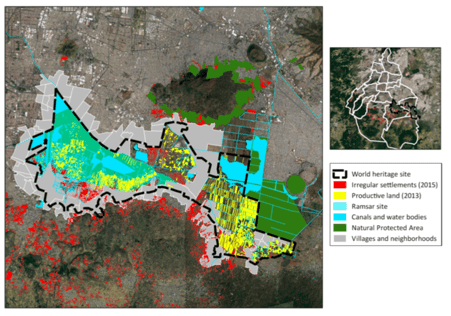
Water quality is a serious issue in Xochimilco, mainly due to the waste waters from Iztapala being fed into Xochimilco but also from illegal sewage dumping. Political action has been taken to protect the land by UNESCO who designated it a World Heritage Site in 1987. Despite this, around 25% of this protected land is urbanised (see below).
Control of the water supply
The city authorities control water extraction from Xochimilco. Over time the local’s grasp of power and control of their water has been eroded, which has dented the self-esteem and character of locals [3]. One local from a study by Eakin et al. (2019) describes how Xochimilco is treated just like any other national scale project such as oil extraction, with little regard for the fact that Xochimilco is an ‘aquatic community’ which now does not have enough water for itself due to the needs of the city.
Identity
Historically there has been a tension in the identity of the Xochimilco area. In one perspective the area has been characterised by farming and as such has been vulnerable to political domination and resource extraction. The perspective held by locals however is that this is an area with a unique eco-system and self-reliance outside of the governmental remit. There is a clash between locals of Xochimilco with extremely strong roots to the area, and politicians that see the area as critical to sustaining the urban life of Mexico City. This quote sums up the situation nicely:
“The water that was once the source of collective identity and spiritual meaning for the population (spring), is now a source of repulsion (treated waste), and an impediment for those struggling to maintain self-efficacy in relation to their traditional way of life” [4]
[1] Morehart, C. 2018. The political ecology of chinampa landscapes in the Basin of Mexico. Pages 19-39 in E. Holt, editor. Water and power in ancient societies. IEMA Proceedings. State University of New York, Buffalo, New York, USA.
[2] Eakin, H., R. Shelton, J. Siqueiros-Garcia, L. Charli-Joseph, and D. Manuel-Navarrete. 2019. Loss and social-ecological transformation: pathways of change in Xochimilco, Mexico. Ecology and Society 24(3):15
[3] Ibid.
[4]Ibid.
 Urban Political Ecology UCL