Montreal is situated in Canada, whose water abstractions per capita, were the second biggest of the OECD countries in 2011. A McGill university webpage indicates that the average Canadian uses about 329L of water every day and that according to the Ville de Montréal, the average Montrealer uses 225L everyday. To compare, on the website of the mayor of London, we can find that ‘currently, the average Londoner consumes 164 litres/day’. In Montreal such as in London, there are important leaky pipes issues that lead to make drinkable much more water (between 20 and 40% in Montreal) than what is really consumed. The Ville de Montreal mentions freeze-thaw and salt use on road as factors aggravating the pipes deterioration.
Nevertheless, Canada is the fourth freshwater reservoir in the world. In Québec. The equivalent of 3 times the surface of France is covered of Fresh water (Brun & Lasserre, 2006). The city of Montreal have no problem to find enough fresh water for its inhabitants and their high consumption.
This abundance and the lack of water meters are some of the reasons of the high fresh water consumption in Montréal. Public authorities try to reduce water consumption, notably to reduce the costs of water treatments partly borne by consumers. TheSQEEP (Stratégie québecquoise d’économie d’eau potable: Quebec strategy for saving drinking water) asked for a reduction of 20% of the consumption by 2017 when it was implemented in 2011. The Ville de Montréal chose to install water meters in commercial and industrial buildings for a better water management and a better understanding of the consumption.
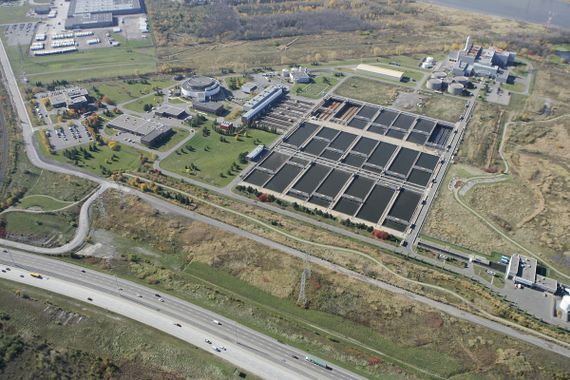
Water treatment includes both treatments before and after the consumption. Before 1984, sewage were not treated and went directly to the river through the sewerage network. According to Guisy Lofrano and Jeanette Brown, ‘for the longest time, dispersion and dilution have been the predominant but not the best practice for management strategies’ in the world. Now, we find them mainly in developing countries (Lofrano & Brown, 2010, p. 5263). Concerning sewage treatment, Montreal was a bit late in comparison with its North American neighbours. Even if the sewerage network is older, sewage have been treated only since 1984 with the opening of the water treatment plant Jean R Marcotte. It is the largest in North America and the third largest in the world. It treats all the sewage waste of the island of Montreal and approximately 50% of the sewage waste of the province of Québec.
Through the history of wastewater management, we note that improvements in this domain for dispersion and then for treatment were motivated by health reasons (Lofrano & Brown, 2010). Large epidemics often participated to raise awareness. It was the case in Montréal with epidemics of cholera and typhus in the middle of the 19th century that motivated the construction of the first sewerage network of the city.
Improvements in sewage treatments are motivated by both health and environmental reasons. By releasing a cleaner water in the river, we protect both the fauna of these rivers and the health of population downstream. A study highlights an impact of effluent in Montreal on rainbow trout health, even after water treatment (SALO et al., 2007). The actual process of Montreal’s sewage treatment plant doesn’t get rid of all micro-organism and medications. We can hope that the new ozonization equipment will improve significantly the quality of the water released in the Saint-Laurent River.
References
Brun, A., & Lasserre, F. (2006). Les politiques territoriales de l’eau au Québec (Canada). Développement Durable Et Territoires, (Dossier 6). doi: 10.4000/developpementdurable.2762
Canadian Consulting Engineer. (2015). Montreal’s gigantic sewage treatment plant adds ozone disinfection. Retrieved from http://ville.montreal.qc.ca/portal/page?_pageid=6497,141709696&_dad=portal&_schema=PORTAL
CBC news. (2015). Montreal upgrading wastewater treatment with ozone. Retrieved from https://www.cbc.ca/news/canada/montreal/montreal-upgrading-wastewater-treatment-with-ozone-1.3005508
Gouvernement du Québec. (2019). Stratégie québecquoise d’économie d’eau potable. Retrieved from https://www.mamh.gouv.qc.ca/fileadmin/publications/grands_dossiers/strategie_eau/strategie_eau_potable.pdf
Lofrano, G., & Brown, J. (2010). Wastewater management through the ages: A history of mankind. Science Of The Total Environment, 408(22), 5254-5264. doi: 10.1016/j.scitotenv.2010.07.062
Misachi, J. (2020). Which Country Has the Most Fresh Water?. Retrieved 24 March 2020, from https://www.worldatlas.com/articles/countries-with-the-most-freshwater-resources.html
OECD. (2014). OECD Factbook. Retrieved from https://www.oecd-ilibrary.org/docserver/factbook-2014-en.pdf?expires=1584974527&id=id&accname=guest&checksum=7035BD282BB76E6E20F699D692633447
Policy 5.15 Water use and supplies. (2020). Retrieved 24 March 2020, from https://www.london.gov.uk/what-we-do/planning/london-plan/current-london-plan/london-plan-chapter-five-londons-response/pol-14
SALO, H., HEBERT, N., DAUTREMEPUITS, C., CEJKA, P., CYR, D., & FOURNIER, M. (2007). Effects of Montreal municipal sewage effluents on immune responses of juvenile female rainbow trout (Oncorhynchus mykiss). Aquatic Toxicology, 84(4), 406-414. doi: 10.1016/j.aquatox.2007.06.014
Ville de Montréal – L’eau de Montréal. (2020). Retrieved 24 March 2020, from http://ville.montreal.qc.ca/portal/page?_pageid=6497,54201575&_dad=portal&_schema=PORTAL
Water At Home. (2020). Retrieved 24 March 2020, from https://www.mcgill.ca/waterislife/waterathome
 Urban Political Ecology UCL
This is a nice comparison with my blog on Cape Town- two cities that have a stark contrast in water supply. I am glad to hear that despite Montreal’s relative abundance in potable water, they are making a concerted effort to encourage a reduction in people’s high levels of consumption. Resource conservation is an increasingly important exercise in exhausted urban metabolisms.
The clean up act of Montreal’s river is another highlight and demonstrates the city’s capacity to broaden its sphere of moral consideration to include species other than humans in its scope of justice.
LikeLiked by 1 person
Thanks for sharing this deep-dive into water infrastructure and management challenges in Montreal. It’s interesting to see how even cities with abundant water resources face logistical and distribution hurdles. In Hyderabad, companies like AIWE are stepping in with “bulk bottled water for parties and corporate events” (offered via https://www.aiwe.co.in/lead-collection) to ensure reliable access during large gatherings — a reminder that ensuring safe, accessible water often means tailored local solutions.
LikeLike