Montreal is a North American city with wide spread out suburbs. Even if it has a quite developed public transport network with hundreds of bus lines, 4 subway lines and 6 commuter train lines, it cannot properly serve all the metropolis. On the following graphs we see what share of people going to work uses which mode of transport in the metropolis. We see the curve of Montreal (in purple), of the Greater Montreal (in green) and of elsewhere in Quebec (in grey).
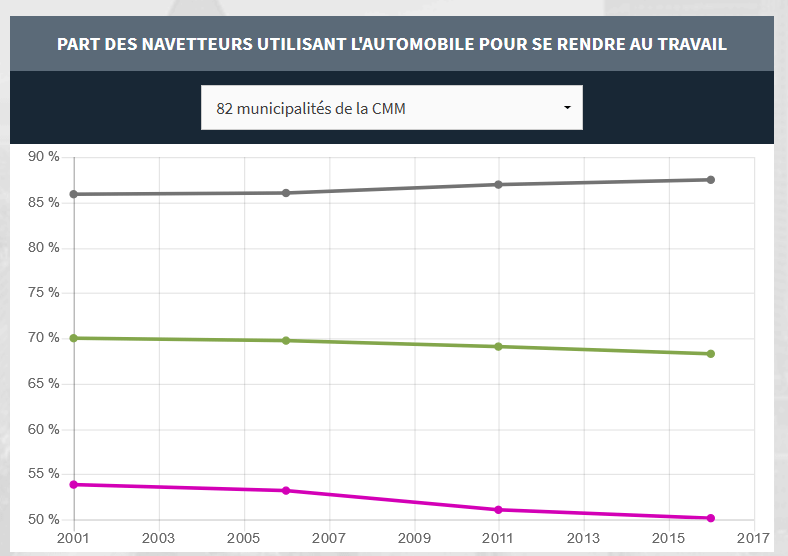
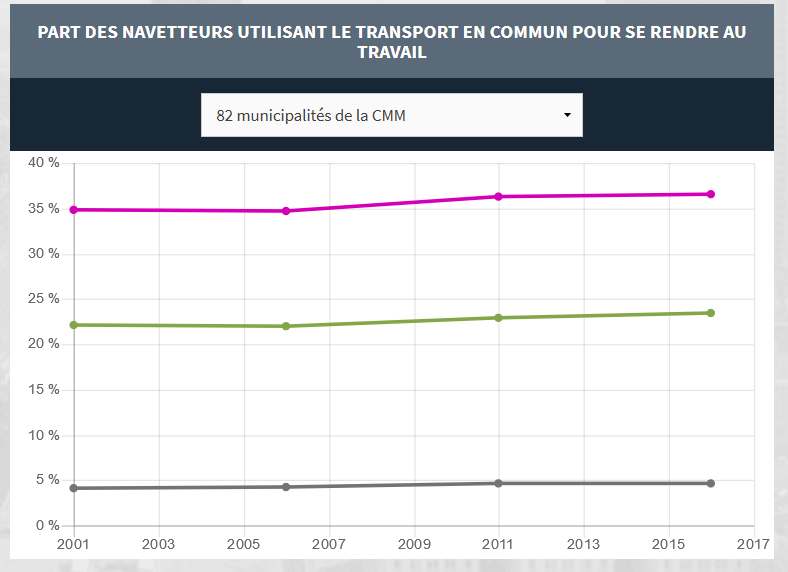
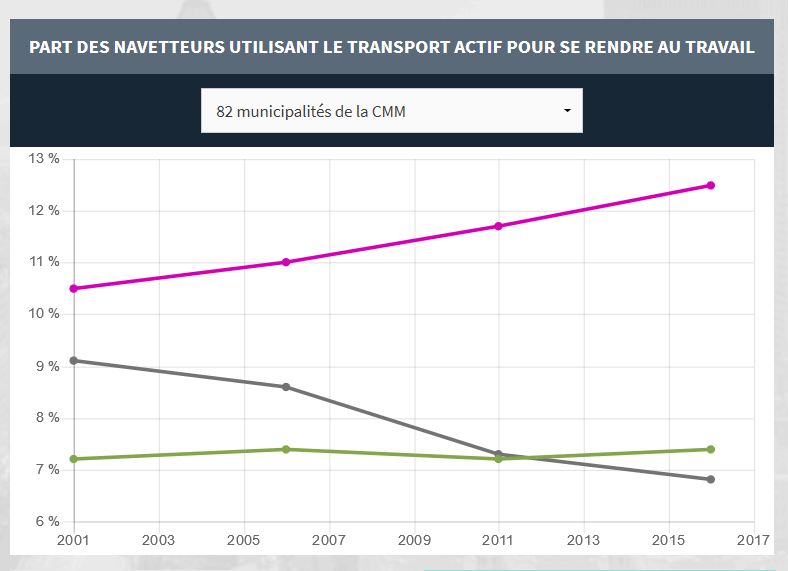
We see that in the Greater Montreal, the share of people using their car to go to work was of about 70% in 2016 and has not really diminish since 2001. In Montreal which is better served than the rest of the metropolis, it was only 50% in 2016. Comparatively, only 28% of Londoners used their car to go to work in 2018.
This large use of cars causes two main problems: traffic jam and air pollution, which was the subject of a previous post. Traffic jam extends the time Montrealers spend in transports, especially of those living in the suburbs. Middle and lower classes that move in the suburbs to find cheaper or bigger housings use their cars and spend much more money and time in transports. A survey published in 2019 indicates that Montrealers spend on average 73 minutes each day to move between their home and their workplace. 81% acknowledge that congestion is a real problem in the region and even more that public transports are the solution.
The Montreal’s subway network inaugurated in 1966 was extended several times until 1988. But since 1988, only 3 stations were added in 2007. The commuter train was luckier with the creation of 4 new lines since 2000. But globally, the public transport network of Montreal and its suburbs suffered of a lack of developments during the past decades. Lots of projects were planned but only a few were built. It seems to change. In Montreal, the construction of a subway line extension has begun and a tramway is planned. At the metropolitan level, the REM (Réseau Express Métropolitain: Express Metropolitan Network) is under construction. This light metro network, will be as long as the current Montreal’s subway network. It will link North West and South suburbs to the city-centre and the airport. It will not use the same technology and will not be managed by the same organism than Montreal’s subway because it is owned by the CDPQ (Quebec Deposit and Investment Fund). Extensions of this network are already proposed.
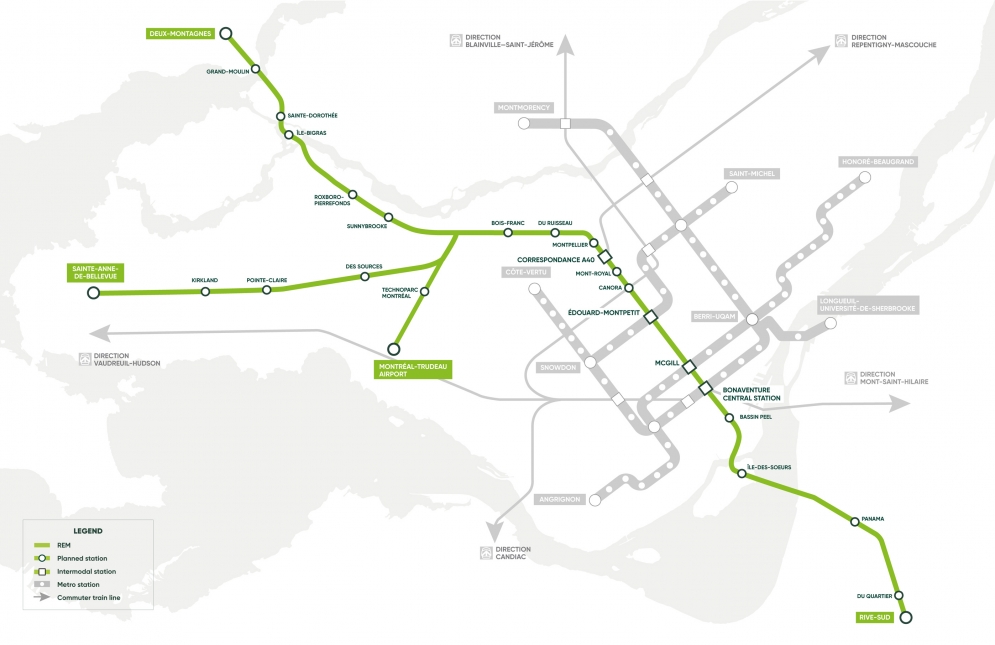
There is a hope of improvements concerning traffic jam and pollution in Montreal in the coming years. thanks to public transports improvements. All the more that cycling become more and more popular on the island of Montreal, supported by the development of the cycling network.
References
Bruemmer, R. (2019). Plante fumes as Quebec considers possible expansion of REM. Montreal Gazette. Retrieved from https://montrealgazette.com/news/local-news/quebec-looking-into-extending-rem-into-laval-east-end-montreal/
d’Angelo, M. (2019). Pour les Montréalais, la solution passe par les transports en commun. La Presse. Retrieved from https://www.lapresse.ca/debats/opinions/201907/14/01-5233912-pour-les-montrealais-la-solution-passe-par-les-transports-en-commun.php
Grand Montréal en statistiques. (2020). Retrieved 3 April 2020, from http://observatoire.cmm.qc.ca/observatoire-grand-montreal/outils-statistiques-interactifs/grand-montreal-en-statistiques/?t=4&st=42&i=671&p=2016&e=3
Lecomte, A. (2019). Un début de ligne rose pour Montréal. Radio Canada. Retrieved from https://ici.radio-canada.ca/nouvelle/1200186/lachine-centre-ville-entente-tramway-quebec-transport-metro-plante
Major metro projects. (2020). Retrieved 3 April 2020, from http://www.stm.info/en/about/major_projects/major-metro-projects
Modal comparisons (TSGB01). (2020). Retrieved 3 April 2020, from https://www.gov.uk/government/statistical-data-sets/tsgb01-modal-comparisons
Plan de décongestion et transport collectif – Votre gouvernement en action pour le prolongement du REM et un nouveau mode de transport dans l’Est de Montréal – Portail Québec. (2020). Retrieved 3 April 2020, from http://www.fil-information.gouv.qc.ca/Pages/Article.aspx?idArticle=2705060687
Presentation of the REM. (2020). Retrieved 3 April 2020, from https://rem.info/en/reseau-express-metropolitain
Tomesco, F. (2019). REM is on track to open by the end of 2021, Caisse insists as delays reported. Montreal Gazette. Retrieved from https://montrealgazette.com/business/local-business/rem-is-on-track-to-open-by-the-end-of-2021-caisse-insists/
Ville de Montréal – Transport – Réseau express vélo (REV). (2020). Retrieved 3 April 2020, from http://ville.montreal.qc.ca/portal/page?_pageid=8957,143276111&_dad=portal&_schema=PORTAL
Ville de Montréal – Transport – Transport collectif. (2020). Retrieved 3 April 2020, from https://ville.montreal.qc.ca/portal/page?_pageid=8957,99627580&_dad=portal&_schema=PORTAL
 Urban Political Ecology UCL
Wow! The contrast in car usage between London and Montreal is stark and the latter certainly needed addressing. I am glad to see the introduction of REM as way to improve public transport links and mitigate the related impacts of car use: traffic jams and air pollution.
Cars are becoming increasingly antiquated vehicles in the eyes of urban geographers. Their initial introduction to the road revolutionised transport and liberated owners. Over time, their USP has somewhat reversed, particularly in urban environments where roads are being overpopulated by cars generating masses of congestion. Rapid transit systems definitely seem the way forward and will hopefully pave the way for pedestrianising roads. Transformations like this will create more equitable urban metabolisms that values people more than cars.
LikeLiked by 1 person