Although a very different viewpoint on Mexico City’s UPE, I am aware that my blog is focuses on the more traditional way of analysing UPE issues. This is a short attempt at branching out from those roots. My focus will be on Mexico City resident and artist Gilberto Esparza’s art and its relation to Mexico City’s UPE. Esparza’s art is very unique and is mostly functional, and he describes his art as ‘research technology’, through which questions can be asked as to how we reduce our human footprint on the earth [1].
This art installation named ‘Plantas Nomadas’ shown below is a fully functioning robot which “is capable of cleaning water from polluted rivers” [2]. It is autonomous and is powered by the waste it collects, in a way this is an interesting parallel to the circular economy idea I explored in earlier blogs. Instead of humans recycling waste to generate money to stay alive, this robot also needs the waste to generate electricity to power itself. Interestingly, it was tested predominantly in the heavily polluted Lerma River which feeds Mexico City.
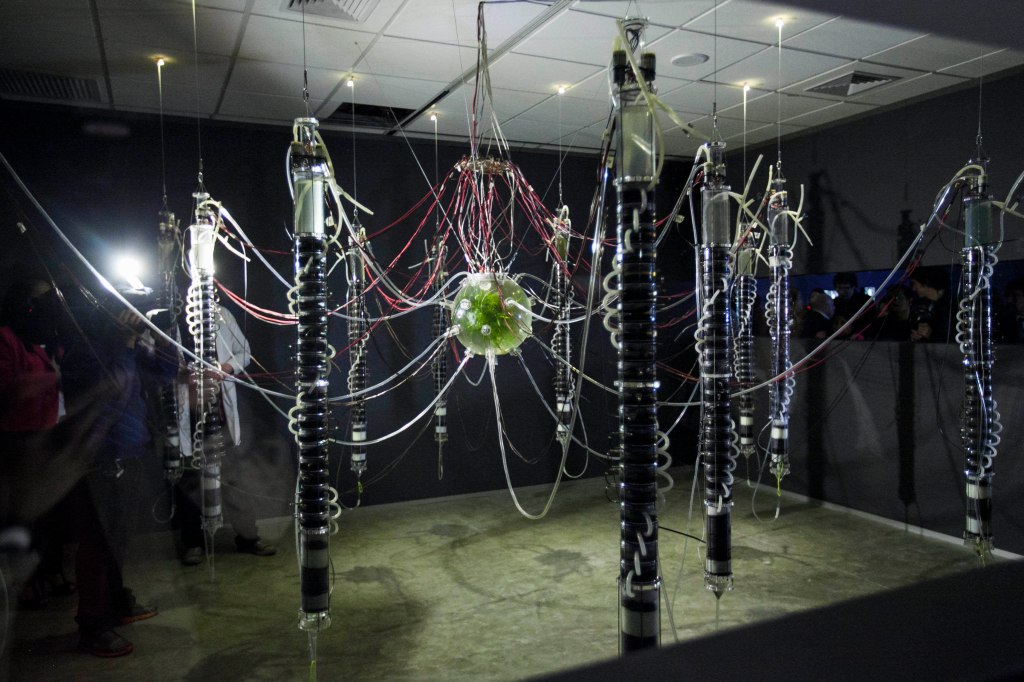
Esperza’s work is more than just art but a representation of the extremely poor water quality in Mexico City. However, the aim is awareness as much as anything to show that solutions are out there.
This post marks the end of my blog, which I have thoroughly enjoyed writing over the past 3 months. In summary, I have explored UPE issues in Mexico City through: green spaces, informal settlements, water, sense of place, and lastly through art.
[1] Gilberto Esperza (2020) ‘About Gilberto Esperza’, (WWW) Gilberto Esperza: Mexico (www.gilbertoesparza.net – accessed 20th March 2020).
[2] Serrano, R.G., 2018. Two Stances on Water: Political Ecology in Techno-scientific Art from Mexico. Hemisphere: Visual Cultures of the Americas, 11(1), p.36.
 Urban Political Ecology UCL
An insightful account of creativity and resourcefulness used to challenge existing forms of governance. A similar incident arose in Rio de Janeiro where locals of the Vidigal community used former sites of landfill and waste materials to produce art murals, a strong critique of waste governance across Rio by municipal management. I wonder how many other parallels there are between Rio and Mexico City, given that it is another city from Latin America.
LikeLike