Back in the nineteenth century, Berlin was known for its swimming spots along the canals of the River Spree. However, due to sewage overflows during periods of heavy rainfall, the Spree canal is now a stretch of murky water, and anyone who would consider swimming in it would simply put themselves at risk of illness. This post will explore an ongoing project which aims to reclaim this canal as a swimming spot by undertaking natural processes.
The decision to address the heavily polluted stretch of water was introduced by the Elder brothers in the 1990’s, and it received heavy disapproval and doubts from critics [1]. Currently featuring as an endpoint for various wastewater discharges, the idea of improving the water quality of the Spree Canal began receiving support by Berlin’s Senate Department for Urban Development and the Environment in 2014 [2]. The project leaders, called ‘Flussbad Berlin’ have a principal aim of creating an ecological water environment with the predominant use of natural processes. These ‘socially mediated natural processes’ have directly addressed a common UPE perspectives of cities as anti-nature [3]. They have planned to designate a 400 yard stretch of the canal for a natural filtration system with the use of gravel beds and reeds which will permit ‘microbiological cleaning’ [4]. While the upper section of the canal is planned to become a place for aquatic life to roam, the project leaders are aiming to provide pedestrians direct access to water with stairs along the river bank [5]. This will ensure equitable access to locals and tourists, while also increasing the number of visitors in the area. Please refer to the video below which depicts a graphical interpretation of the future plan:
However, one of the biggest technical challenges is addressing the overflow of sewerage due to the placement of pipes. The project leaders have since addressed this issue and have planned to build a control structure to retain the wastewater and dispose of it at treatment plants [2]. This project received €4 million in funding from the Berlin and German governments, and has since seen an increase in political and social consensus [2]. In 2018, 100 swimmers raced along the canal to promote the project, which highlights the endeavour of numerous social actors in defending and creating their own environments.
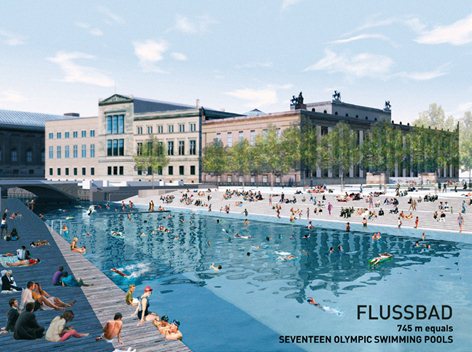
‘Flussbad Berlin’ visualise themselves as ‘part of an international movement that puts the spotlight back on urban rivers as valuable resources’ [6]. They stress that the project will generate social value to the city as well as economic benefits, and aims to be completed within the next 5-10 years. The project portrays the urbanisation process occurring on nature, where the canal has been ‘socially mobilised, economically incorporated and physically transformed’ in order to align itself with the wider process of urbanisation [7]. It is unfortunate that local residents expressed concerns due to the River running alongside Museum Island, a UNESCO World heritage site, stating that conflicts of interests would arise between tourists, swimmers and museum visitors [8]. However, one of the Edler brothers spoke out in response to these concerns, stressing that the changes were merely providing access to a previously inaccessible natural resource. He stressed the importance of communication, claiming that residents opposing the project would ‘lose their fears once they have understood the project details’ [8]. This communication is imperative to ensuring environmental justice principals are followed, and shows the strong efforts of Berlin to address their residents’ concerns.
This project has highlighted how Berlin are becoming pioneers in sustainable urban development, while simultaneously addressing their lack of public recreation and sports areas. It also encourages other cities to partake in such developments, while breaking the perception of local forms of capitalism having a strong tendency to view nature as an externality [9]. This production of nature addresses the perceived separation of nature and society, and will provide Berliners with many benefits to come [10].
Here are the references I used:
[2] – https://en.wikipedia.org/wiki/Flussbad_Berlin_(Project)
[3] – Heynen, N., Kaika, M. and Swyngedouw, E. eds., 2006. In the nature of cities: urban political ecology and the politics of urban metabolism (Vol. 3). Taylor & Francis.
[4] – https://www.flussbad-berlin.de/documents/41139/1047398/Annual+Review+%233/f1e06716-5ef2-4bb6-afe3-9fff25f9ad09
[6] – http://www.flussbad-berlin.de/en/project
[7] – Swyngedouw, E. and Kaika, M., 2014. Urban political ecology. Great promises, deadlock… and new beginnings?. Documents d’anàlisi geogràfica, 60(3), pp.459-481.
[8] – https://cities-today.com/berlins-citizens-reclaim-their-river-after-100-year-ban/
[9] – Swyngedouw, E. and Heynen, N.C., 2003. Urban political ecology, justice and the politics of scale. Antipode, 35(5), pp.898-918.
[10] – Smith, N. (1984) Uneven Development: Nature, Capital and the Production of Space.
Oxford: Blackwell Publishers
 Urban Political Ecology UCL
This is a great initiative, although I don’t think I would go in it! This is one of the first posts on our entire blog which is about positively affecting a city’s UPE. It will be interesting to see if other countries follow the lead of Berlin on this front, even if on a smaller scale.
LikeLike