By living in a major urban centre, the cariocas have effectively distanced themselves from greenery and vegetation. Despite Rio’s geography of mountainous regions brimming with foliage and plant life, the cariocas‘ lack of everyday experiences with greenery suggest that interaction with nature is a scarcity for those in both the hills and asphalt (Guayasamín et al. 2016).
Agro-ecology is defined as the cultivation of food within urban areas, with growers using local resources and basic materials in the process. The growing movement of agro-ecology in Rio is a promising development for community-led engagement with sustainable practices, encouraging cariocas to take on a hybrid lifestyle that bridges the gap between urban and rural livelihoods (Rekow 2015). Great emphasis is placed on healthy eating and sustainable habits; buying locally sourced, pesticide-free, organic food for an affordable price is attractive for communities with little or no access to these means of enjoying the natural.
A lack of space in Rio, as evidenced by the sprawl of favelas and agglomeration of the asphalt, means agricultural practices are limited to small plots of land and back gardens (Torres 2017). However, this hasn’t stopped local-led initiatives from inspiring cariocas to cultivate their own vegetable gardens. In 2011, Regina Tchelly started her own initiative of Favela Organîca in her hometown of Babilônia, aiming to promote agro-ecology as a sustainable form of livelihood. She hosts lectures for both adults and children, sharing with them simple techniques for growing a variety of vegetables and fruits. Tchelly also endorses a zero-waste mindset through cooking lessons, promoting the use of pumpkin seeds, banana peels or watermelon rind. “The mission is to alter people’s relationship with food. To see that peels, stalks, and seeds are food, real food,” (Bunn 2019: n/p).
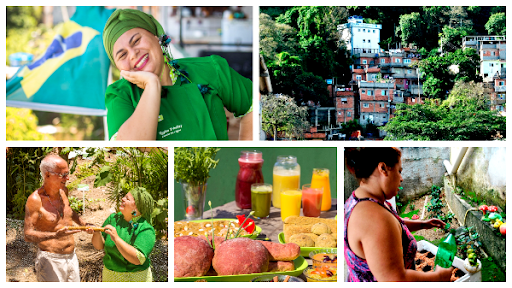
These workshops are crucial for encouraging cariocas to explore alternative networks of food, rather than buying packaged food from the supermarket. By sharing her knowledge with the community, Tchelly helps to foster a collective mindset conscious of waste and urban social issues of food production. Though Favela Organîca is rooted in the community, Tchelly’s workshops have expanded to cities across Brazil and even other countries. She’s even launched her own cooking programme (Amor de Cozinha – “Cooking Love”) dedicated to her aspirations for increasing participation in sustainable consumption.
The national and international recognition of Favela Organîca is testament to the success of Tchelly’s message; there are always sustainable alternatives to the typical lifestyle normalised within an urban metropolis. Thus, forms of environmental education such as Favela Organîca are vital to reimagining the relationship between nature, inclusive citizenship and sustainable development.
List of references:
Bunn, L. (2019) ‘A Feast on Watermelon Rinds and Banana Peels: Favela Orgânica’ (WWW) RioOnWatch: RioOnWatch (https://www.rioonwatch.org/?p=44962: 14 April 2020)
Guayasamín, P.R., Peixoto, R.T.G., Albino, J.C.T., and H.R. Hernández (2016) ‘Value chains for organic products in neighboring municipalities of Rio de Janeiro, Brazil’, Brazil, Agroecology and Sustainable Food Systems, 40, 4, 352-380.
Rekow, L. (2015) ‘Fighting insecurity: experiments in urban agriculture in the favelas of Rio de Janeiro’, Fields Actions Science Reports, 8.
Torres, J. (2017) ‘Urban and Peri-Urban Agriculture, and the Growth of Community Gardens in Rio’ (WWW) RioOnWatch: RioOnWatch (https://www.rioonwatch.org/?p=36826: 14 April 2020)
 Urban Political Ecology UCL
This is a really interesting approach to promote sustainability among urban dwellers. I can see how it can effectively break the norms of the community, who would tend to produce a lot of plastic waste. By educating these people to work together is a really smart long term initiative for Rio.
LikeLiked by 1 person